Ordinary Lens
A Thought On The Everyday
The Ordinary Statement
And How I Got There
Article By Al Lykon – September 2026
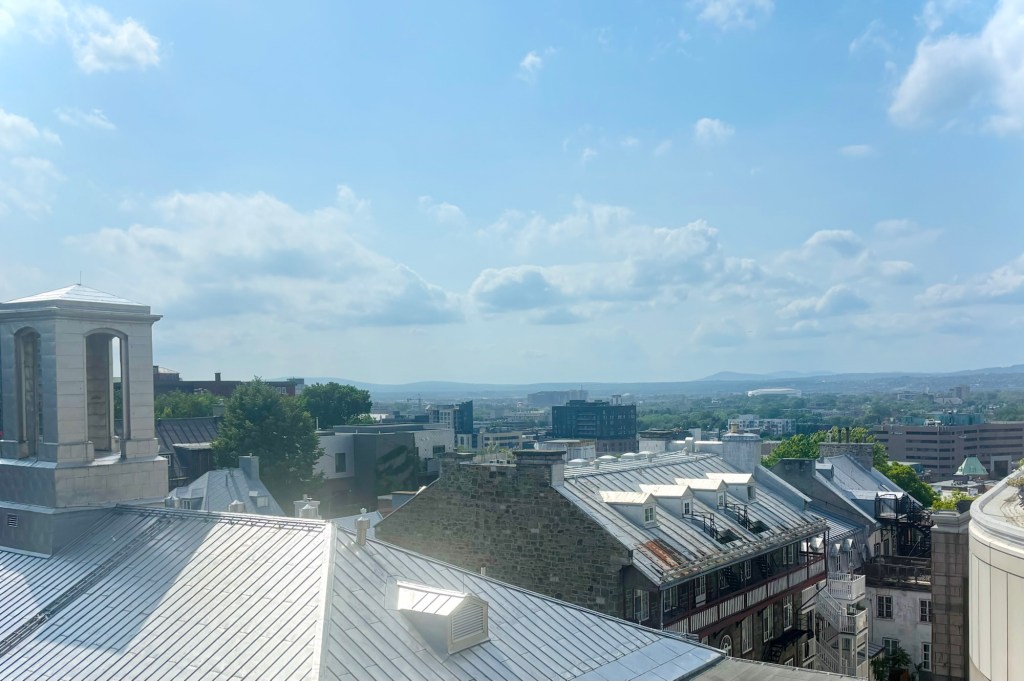
Rooftops (QC)
How It Started
I remember it was getting closer to the end of summer, and I had been talking to a friend about cameras and photo composition. This was right after I had ordered my Klik Camera, which was still en route. If I recall correctly, we were texting details about the camera: her friend had been using one, and I had read almost every online article I could find about it. There was a lot of excitement surrounding our conversation, as we both agreed that it was well worth the investment. I remember telling her that she should totally purchase one, too, for her travels and other miscellaneous adventures. Half-truthfully and half-jokingly, she responded, “So… I might’ve dropped, like, 500 bucks in a week…” but even so, she was certainly interested in purchasing one in the near future. That being said, out of excitement, she began brainstorming all the cool and unique places she would take the camera to capture, quote-unquote, “good” pictures. That sparked a question in my mind: Do photos need to be taken in special locations for them to be considered “good”?
With this in mind, I began to wonder, “Why is our default assumption ‘good’ photographs come from ‘good’ places?” I paused the conversation for a moment and looked up from my phone. It took me a second to collect my thoughts, but I realized something fundamental: the “good” in a photograph doesn’t necessarily come from something “memorable” or “important”; it comes from the amount of attention and intention the photographer puts into taking the photo. Sometimes, if not most of the time, a photograph can be beautiful without a massive, famous castle or a giant statue of Jesus (sorry, Rio). You could walk through your flower garden at home and, with enough care and effort, take a shot just as fairytale-esque as the tulip fields in Holland. Beauty can be found in the places directly around you—in the ORDINARY, not necessarily an entire plane ride away. It all depends on how much time you are willing to spend behind the LENS.
Now, all that being said, I’m not here to discredit professional photographers—that’s not the point I’m trying to make. Travel photography and professional work hold their own sense of wonder and awe. Rather, the point I want to emphasize is that there is just as much beauty in the everyday and ordinary as there is on any high-end vacation or travel trip, at least from behind the camera. Beauty can be found in the everyday, not necessarily in the elite or extraordinary. And that brings us to the idea that “the everyday is worth a snapshot.” Something as simple as a sunset in your front yard or a midnight street during a late-night drive can capture a stunning memento of everyday life—sometimes even more meaningful than a selfie with the Mona Lisa. There is something about the small and simple that naturally attracts the human eye. Maybe it is because these moments are so easy to overlook, but when we stop and take the time to truly see them, we realize that the ordinary can be extraordinary.
A Thought On The Everyday.
-Al Lykon
Comments? Drop A Thought Here.



Leave a Reply